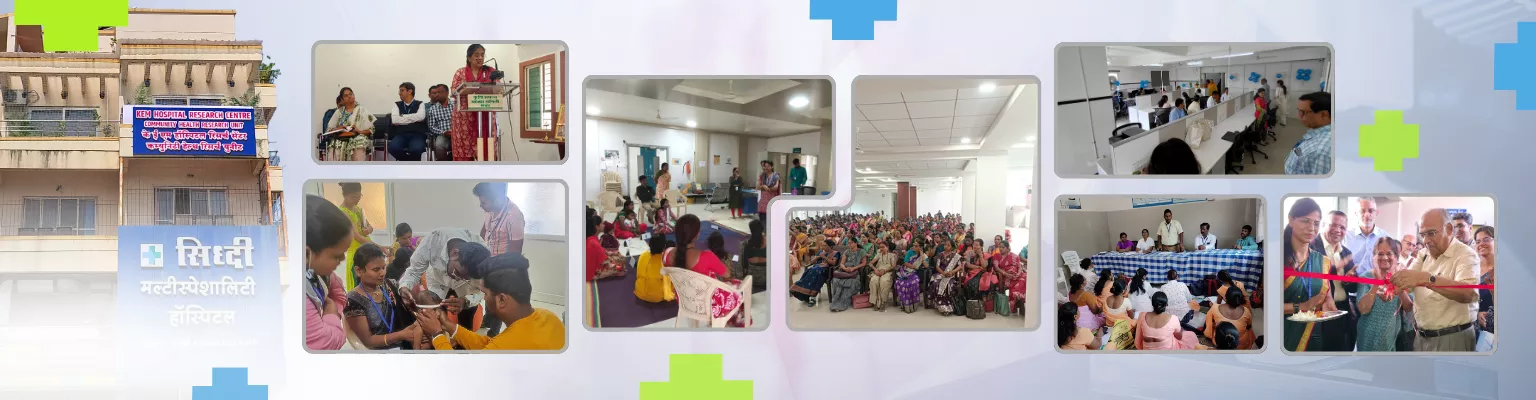
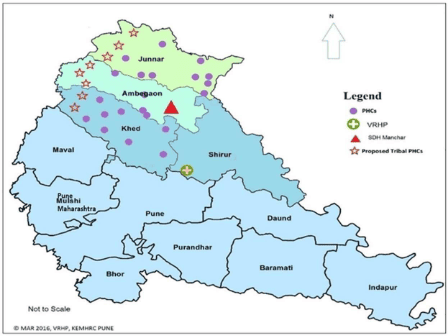
In 2015-16, the VRHP research group expanded its study area to the northern part of Pune District to include Khed, Ambegaon, and Junnar blocks; spread across 500+ villages, the study area had an estimated population of around one million, and about 18,000 annual births. Implementation research was to be conducted in collaboration with the Public Health System (including facilities of 29 PHCs, three rural hospitals, and one sub-district hospital – SDH). Initially, the KEM research team was housed at the SDH but as work increased, KEMHRC established its own office at Manchar.
On 26th January 2022, KEMHRC recognised this research facility as yet another department, calling it the Community Health Research Unit (CHRU). The following figure indicates the area covered by the CHRU, and public health facilities in this area.
CHRU’s first project ― ‘Early Implementation of Rollout of Rotavirus Vaccine in Public Health System’ ― aimed to introduce an indigenous rotavirus vaccine in India in a phased manner through relevant Government agencies. A network of private and public healthcare providers was created as part of sentinel surveillance. This project provided a unique opportunity to broaden the Unit’s research portfolio, especially in collaboration with the public health system.
The public health system being one of the most important stakeholders, helped to strengthen the Unit’s ability to conduct implementation and translational research. For many of these projects, KEMHRC provided technical oversight, training, monitoring, and initial handholding, while the public health system was primarily responsible for project implementation.
Research Activities
CHRU focuses on working with public health systems to generate evidence for public health interventions. Most of the research studies are conducted in collaboration with the public health systems. Among the notable studies are:
1. Rotavirus Vaccine (BBIL) rollout in Public Health Systems and sentinel surveillance of intussusception.
2. Possible Serious Bacterial Infection (PSBI) study ― an innovative approach to simplify the management of sick infants where referral is not possible in a rural area.
3. A study to assess uptake and sustained use of cleaner cooking fuel (LPG) through Pradhan Mantri Ujjwal Yojna (PMUY).
4. Assessment of the feasibility of introducing pulse oximetry in IMNCI services in primary health facilities in Pune district.
5. Phase III, multicentre, randomised, double-blind, placebo-controlled study to evaluate efficacy of probiotic supplementation for prevention of neonatal sepsis in 0 to 2-month-old Low Birth Weight (LBW) infants in India. This ongoing study is crucial as reduction in infectious morbidity with probiotics intervention among most at-risk LBW infants is likely to impact neonatal mortality, growth, and development
Infrastructure Upgrade
During the recent COVID-19 pandemic, the Government of India’s Department of Biotechnology (DBT)-Biotechnology Industry Research Assistance Council (BIRAC) selected and funded KEMHRC under ‘Mission COVID Suraksha’; this enabled KEMHRC to strengthen its institutional capacity in order to accelerate efficient conduct of human clinical trials on vaccines for COVID-19, both at the hospital and the community-based location at CHRU. A state-of-the-art clinical trial unit was developed as per industry standards. The current infrastructure includes (but is not limited to):
1. 2- to 8-degree industry make refrigerators (2 units)
2. -20-degree deep freezer (1 unit)
3. Centralised Temperature Monitoring System
4. Bio-Safety Cabinet (BSL II)
5. Cooling Centrifuge Machine
6. Barcode Reader Printer
7. Defibrillator, ECG Machine, Multipara Monitor
8. Oxygen Concentrator Machine
9. Online UPS and 24×7 Power back-up
10. Audio-Video Recording System for Informed Consent Process
11. Video Conferencing System for Meetings and Training
12. Call Centre Facility
CHRU now looks forward to scaling up operations in this geographic area to include regulatory vaccine studies of national and global importance along with continuing implementation research in collaboration with the public health system.
Studies
Sr.No.
Study Title
Principal Investigator
Duration
Ongoing / Closed
01
Microbiota-directed complementary foods (MDCF) to treat children with moderate acute malnutrition (MAM) in the first two years of life – open-lab randomised controlled pre-proof of concept study
Efficacy and safety of Punarnavadi Mandura alone and in combination with Drakshavaleha compared to iron folic acid in the treatment of moderate iron deficiency anaemia among non-pregnant women of reproductive age group: a community-based three arm multicentre randomised controlled trial
Phase III, multicentre, randomised, double-blind, placebo-controlled study to evaluate efficacy of probiotic supplementation for prevention of neonatal sepsis in 0-2 months old Low Birth Weight infants in India
Research cum intervention multicentric study to strengthen National TB Elimination Programme (NTEP) by implementing programme guidelines for TB using novel strategies to address the various challenges faced by the programme in selected states and specific population/communities in India
A study to assess uptake and sustained use of cleaner cooking fuel-LPG through Pradhan Mantri Ujjwal Yojna (PMUY) revealed barriers such as accessibility and affordability, which need to be addressed for better uptake.